



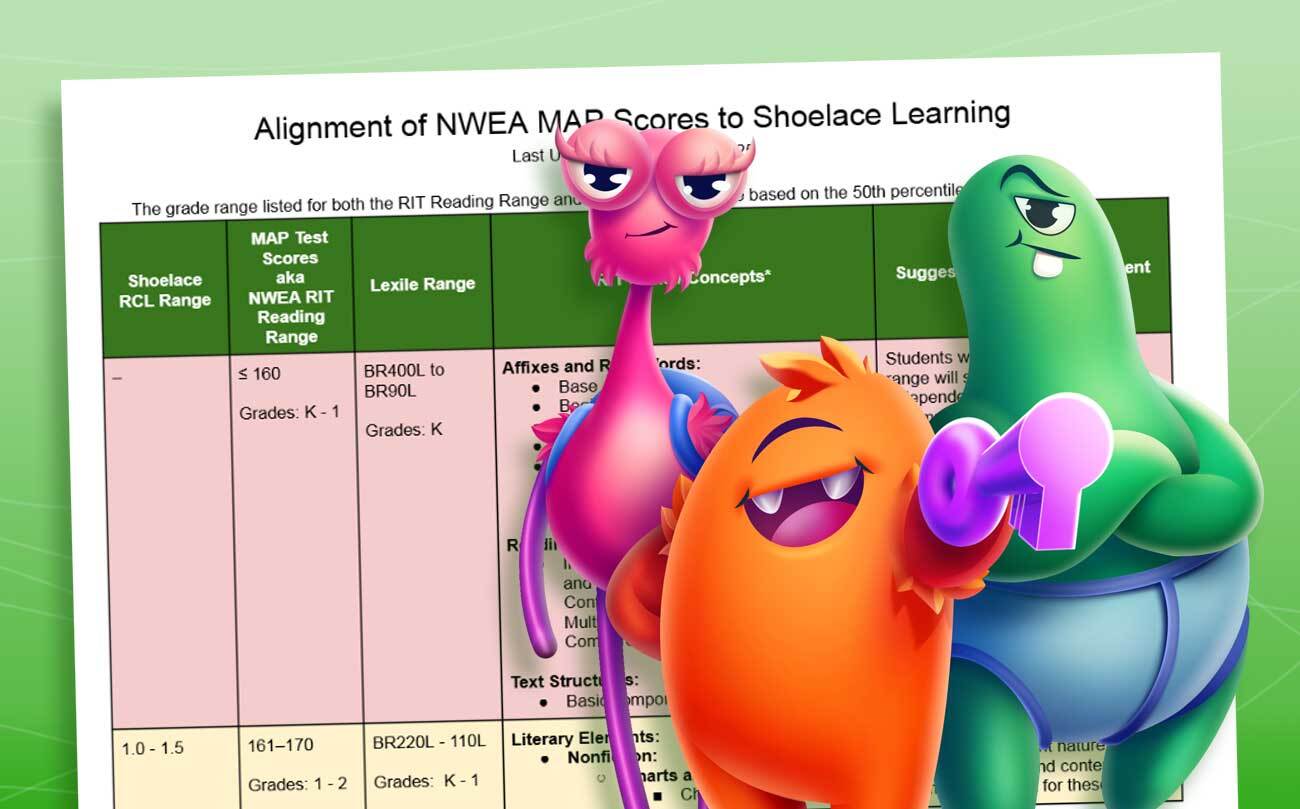
We have developed a NWEA MAP Score to Shoelace alignment document to help guide you in choosing from our vast assignment library based on their RIT score. You can download a copy of the document here.
After your students complete their NWEA MAP Reading assessment you get handed a new RIT score for every student. Which is great, right? More data, what’s not to like. Except, what are you supposed to do with it? Like all education data, it’s only useful if you can (and do) actually use it to inform your teaching.
That’s why we’ve developed a document that aligns RIT scores with Shoelace content (and also Lexile scores).
Shoelace’s Learning Engine is always adjusting the content for your students to match their needs, the Engine does its best when it comes to addressing breadth of knowledge. Here’s where you come in — with your students’ RIT scores in one hand, and Shoelace’s data reports in your other, you can isolate the skills where your students need further targeted practice and inform your teaching.
Now, let’s start with a general caveat that is true for every single program/curriculum out there (seriously, this is true whether we’re talking about the NWEA MAP assessment, Common Core Curriculum or state tests like the Michigan MET): Every program/curriculum has its own ordering of skills and assumptions about reading development. This is important to note and remember because it’s also where you run into one of the (many) big flaws behind “teaching to the test.” If you teach based on your state’s test, you will be slightly out of sync with the NEWA MAP and vice versa (or whatever second program or test you look at). The result is that your students may have slightly lower scores on a different assessment, because that assessment assumes your students should’ve already mastered skills your first assessment doesn’t. What this means, is that you should always approach test scores as only being a piece of the data, not the whole data.
You’ll see this reflected in our alignment document.The ranges for students’ RCL, RIT grade and Lexile scores overlap. So when you’re looking at the alignment based on a specific score for your student, be sure to check the above and below rows as well, for additional practice topics.
Background On Shoelace Skills
As mentioned above, the Shoelace Learning Engine works to improve students’ reading comprehension by focusing on expanding the breadth of their skills. At any given Reading Comprehension Level (RCL), students will be exposed to a minimum of 50 different skills in the Shoelace platform (from a set of over 100 skills). This means that students who are primarily engaging with Shoelace via the learning engine (i.e. their teacher is not assigning specific practice through assignments) will be given lots of different skill development, but less depth on any specific skill.
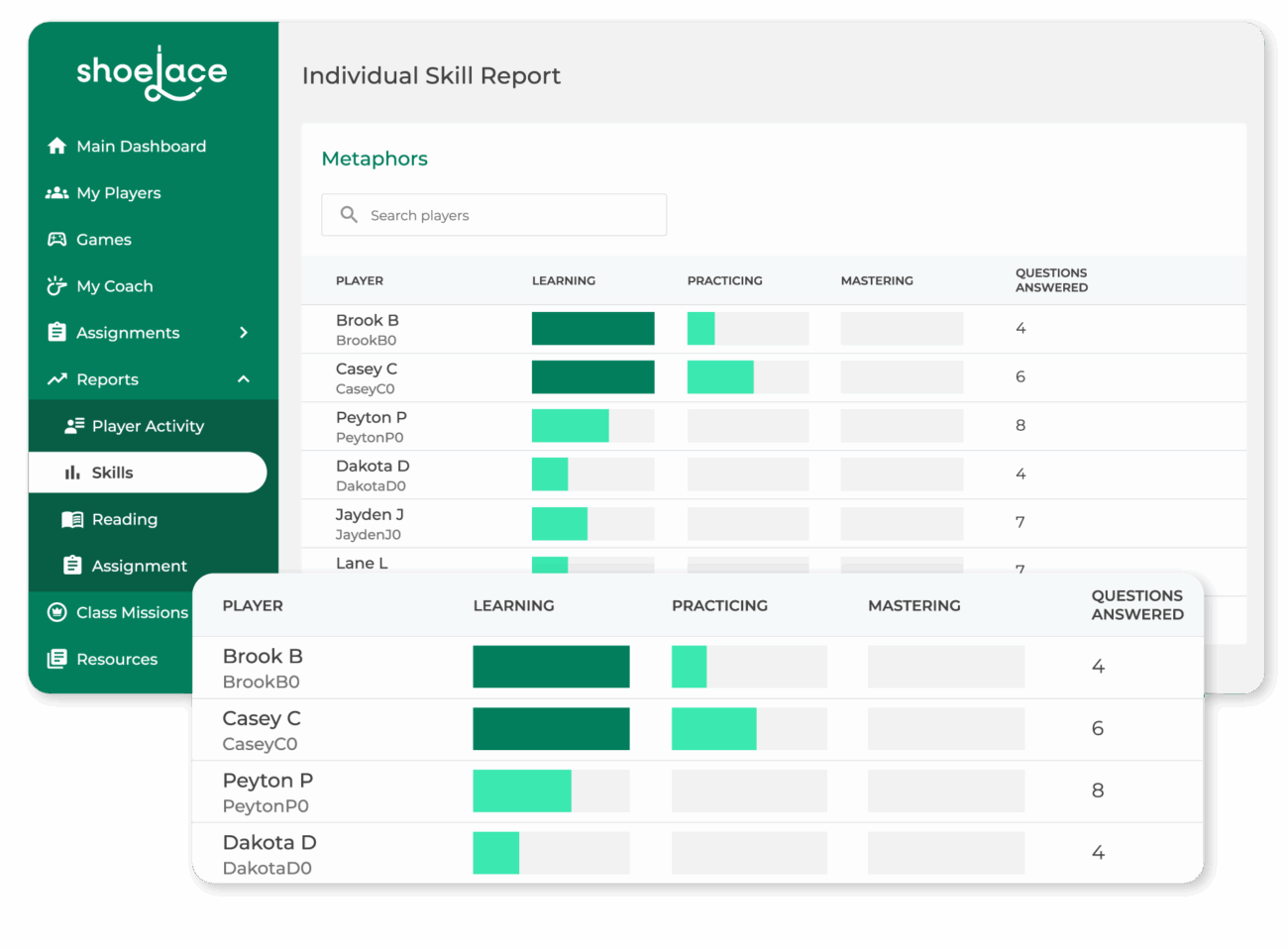
The skill report will help you better understand your students’ breadth and depth across the various skills. There, you can look at the data from a class view, or dig down into individual student reports. All students start out in each skill in the Learning Tier. As they demonstrate understanding, they will progress to the practicing tier, and then finally the mastery tier. The movement up these tiers can be seen as illustrating a student’s depth of knowledge on a specific skill. The number of skills you see for a specific student illustrates the breadth of coverage.
It’s also important to note that not all skills are practiced in the same way. Some skills are only practiced as independent skills (like Basic Punctuation). That means students will not see questions for these skills when responding to a passage. On the other hand, there are skills that are only practiced in combination with a passage (like Author’s Purpose). For these skills, there will always be a passage that a student will be referencing. And finally, there are some skills that are practiced in both (like Alliteration), where students might encounter questions as part of a passage, or in isolation as an independent skill.
How To Use the Guide
Below I lay out two different ways to use the guide:
- First, if you are looking for whole class or Tier 1 level support.
- Second, if you are focused on Tier 2 or small group instruction.
For Tier 1 Support:
- Start by looking at your students’ RIT scores. NWEA MAP groups them by a range of 10 (like 191 – 200 or 211 – 220). Identify the most common range for your students.
- Use that range to find the correct row (focus on the MAP Test Scores column / second column).
- The RIT Skills column (column 4) highlights the main skills that students in that range need to master in order to move up.
- The Suggested Shoelace Assignments column (the last column) identifies specific skill assignments along with passage assignments that best align with the RIT skills in development.
If you are choosing a Skill assignment, consider the following to help you choose which Tier (Learning, Practicing, or Mastering):
- Use Learning skill assignments to introduce a new skill / one that they do not have much progress on.
- Use Practicing skill assignments to continue to work on developing that skill.
- Use Mastering skill assignments to cement mastery.
For Tier 2 Support:
Consider grouping students either by their RIT or by their Shoelace Skill Scores (or a combination of the two).
- Given a specific skill, look at the skill score report to identify where students are, and group them by what tier they are in (learning, practicing, mastering).
- Group students based on amount of practice on a given skill. Use the “Total” column on the Player view of the skill report. This is the # of questions a player has attempted on a given skill.
- Identify skills where a student has had very little practice (less than 5) and group with other students with similar needs. Assign these students a Practice level assignment for the skill.
- Identify skills where a player has a large total (>15) and is still in the Learning Tier. This is a skill the student is specifically struggling with and then group with similar students. These students would benefit from some direct teacher instruction on the skill, followed by a Practice level assignment in Shoelace.
- If your students have a wide range of RIT scores, group students by their RIT range, and then choose from the suggested assignments (see Tier 1 support steps above).
An extra benefit of using Shoelace assignments, is the assignment reports. This will give you deeper insight into how your students did on the given skill/practice and can be used to determine what step to take next.
Districts and schools are being asked to deliver faster literacy gains with the data and instructional time they already have.
Download the MAP–Shoelace Alignment Guide to support accelerated reading growth—particularly for adolescent learners who are hardest to move.
Schedule a leadership or teacher walkthrough to explore how your district or schools can use this guide to support instructional planning, Tier 1 and Tier 2 literacy, and engagement for grades 4–9.